
Zigging and Zagging
Egypt and Base Ball

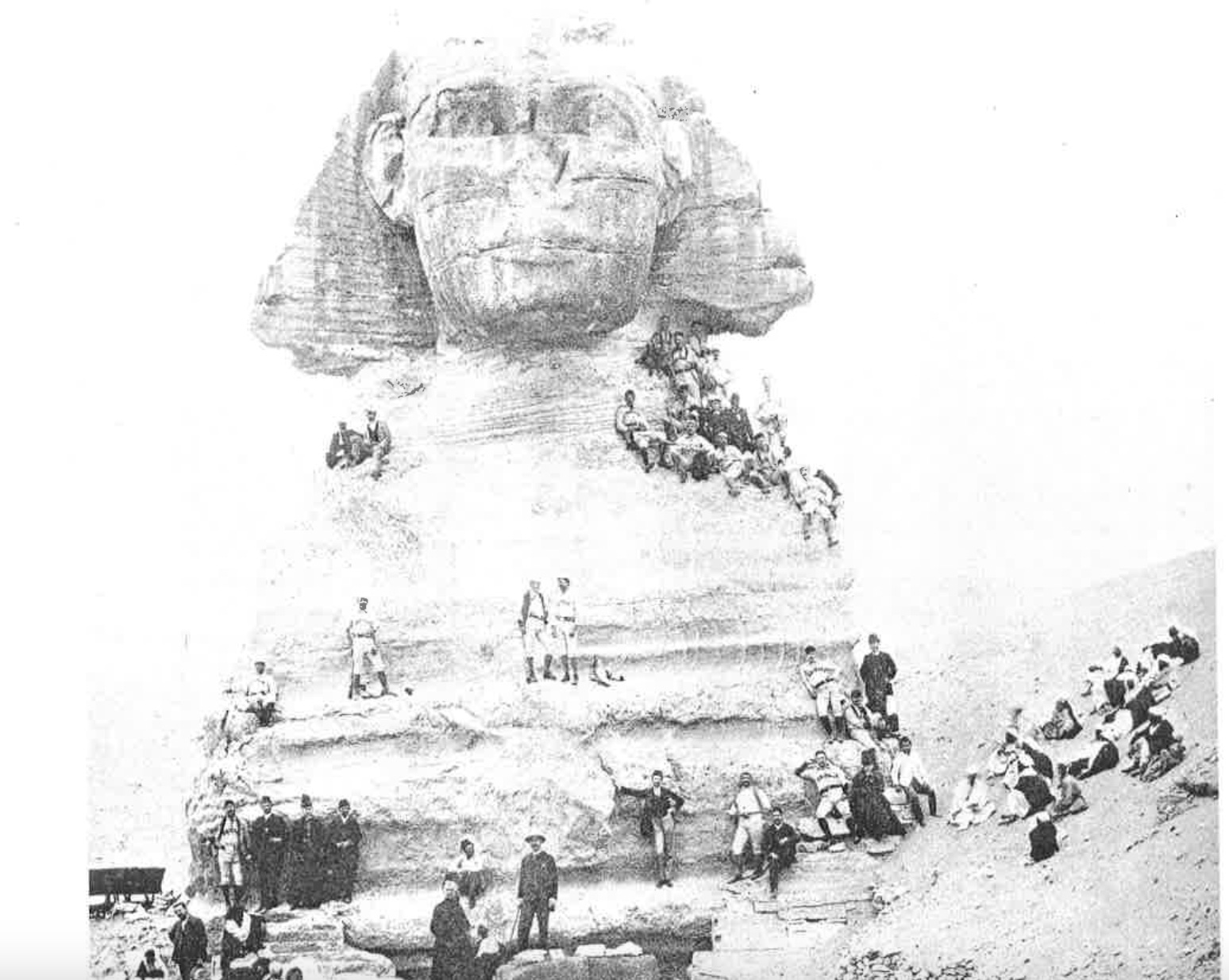
From Lewis Carlson, “The Universal Athletic Sport of the World” American History Illustrated (Vol XIX, No, 2 1984): 41
A Game in Giza
Jon Tener dug his foot into the hard, rocky dirt. The yellowish earth didn’t give much, even when he put all his big frame into it, but he needed a good pivot point if he was going to put on a show for the 1200 people there. Some of the spectators were Arabs or Bedouins or Mohammedans or Turks or Egyptians. Others, different in his eyes on a fundamental level from the first group, were French or Europeans or tourists. He looked at George “Dandy” Wood, who he had shared a few drinks with on the steamer ship when it was chugging into Suez. It was a short glance because his eye was drawn to the the Sphinx behind him. Let’s not tell too many people that all the ballplayers, Tener and Dandy included, took chances trying to hit the old thing in its right eye before the game.1
The spectators were arranged on either side of the diamond so they could see Tener, Dandy, the Sphinx and the Pyramids. It wasn‘t much of a field, and when a ball was hit hard enough it would work itself into the sand. Albert Spalding had arranged to have the dust leveled properly before the game. It reminded Tener of the Arizona desert. He and the rest of the Chicago White-Stockings had rode donkeys to the field. Dandy and the Americans had rode camels. The White-Stockings were a bit cross, although they would never tell Spalding, because they could ride donkeys at home. It was February, and the weather was colder than expected but still quite nice. It had already been a long tour, starting in October in the United States, and there was more to come. They were going to travel around the world for base ball, or so said Spalding. They played Cricket and braved ill-appetite, conquered fatigue and sea sickness, and even saw a parachute performer smash his legs up, all in the name of base ball. Spalding was a true believer in the game. He would say later “Baseball is the exponent of American courage, confidence, combatism; American dash, discipline, determinism; American energy, eagerness, enthusiasm; American pluck, persistence, performance; American spirit, sagacity, success," and so was Jon Tener, he would serve as the president of the National League.2 It’s hard to say if he was more associated with that or his time as Pennsylvania governor.
He jabbed his foot once more into the ground, set, and wound up. Dandy took a big swing and smashed it. Tener should have put a bit more on it, but all the touring had tired him.
They had arrived at Suez at 10 am on Thursday after braving the quay with all the Arabs looking for their baksheesh, then boarded a train that would bring them to Cairo. It stopped in Ismailia and then in Zagazig, where they had the first real meal of the trip. Filled with warm meat, soft bread, and fresh fruit, they rode the rest of the way to Cairo, where they arrived at 7 pm. The next day, the Mohammaden Sabbath of Friday, they went and saw the dervishes. One of his teammates Jimmy described it in such detail that it deserves a full recounting
The priests form a circle with the high priest in the centre, each in his stocking feet and standing on goat skins. The exercises proceeded with the high priest chanting and amid the beating of tamborines the rest follow and continue swinging their bodies two and fro until some of them fall exhausted on the floor. while many others get as excited that they act like madmen and actually froth at the mouth. A good number of European ladies and gentlemen were present and many of them thoroughly frightened, left the temple. After the services closed we returned to town and saw many places of interest, namely, the citidel, which is a strong fortress commanding the city.3
It was an odd ceremony in the land of Moses. Then they stopped by Muhammad Ali’s mosque and the British barracks.
The next day was the day of the game, but before they played their caravan of donkeys and camels had stopped in front of the American consul and gave a rouse. Then they went to the Pyramids, climbed them, took pictures, and tried to heave a ball over them and did the same with the Sphinx.
Only after all of that did they play. And so he was not surprised that his arm felt jellied and Dandy put a charge into it. As it landed, the locals rushed to the ball and squabbled for it in the sand. The White-Stockings would go on to the lose, in five innings, which they figured was enough. They all felt they have played one of the most unique games in the annals of base ball.
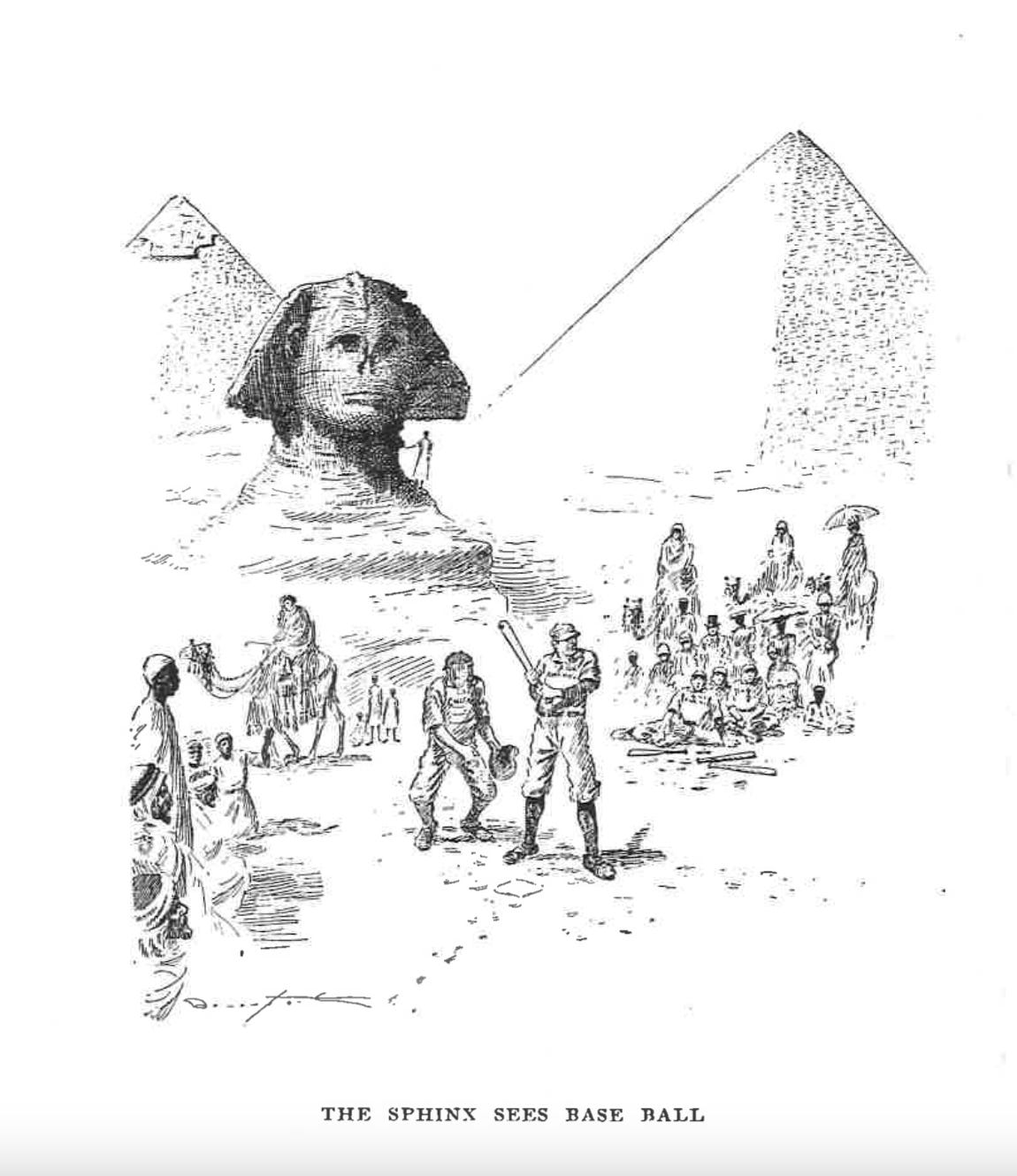
from A.G. Spalding’s America's National Game,Historic Facts Concerning the Beginning, Evolution, Development and Popularity of Base Ball with Personal Reminiscences of Its Vicissitudes, Its Victories and Its Votaries (American Sports Publishing Company, New York, 1911)
Baseball In Egypt?
The game was settled at 10 run to the Americans, an all-star team made from the National League and the American Association, and 6 runs to the Chicago White Stockings, the best team in baseball in 1889 and the baby of Albert Spalding. He was the driver of this world tour and he was an evangelist for the game of baseball. It may seem odd today that someone would believe they could convert Egyptians to baseball, but it perhaps was not.
It is purported that the Ancient Egyptians were the first to play a game that looked like baseball, or hockey, or lacrosse. Basically, they had a stick and ball and that is good enough for people looking for an ancient origin of their sport. If Albert Spalding knew of that, he probably would have taken it, but he didn't. He did believe his Tour of 1889 would convert the world. That’s what many Americans were trying to do at the time. In Egypt in particular, Spalding’s baseball evangelism mirrored the more commonplace religious evangelism: the Presbyterians and other Protestants were coming to the county to try to convert the natives, under the protection of the British occupation. The British had invaded Egypt in 1882, and it is far from coincidental that Spalding’s tour hit Melbourne, Sydney, Columbo, Glasgow, Dublin, and Cairo. It was a tour made possible by colonialism.
Spalding was disappointed that baseball did not immediately catch on in Egypt saying:
In a country where they use a stick for a plow, and hitch a donkey and a camel together to draw it, . . . it is hardly reasonable to expect that the modern game of baseball will become one of its sports.4
It probably had nothing to do with inferiority and more to do with the lack of familiarity. Americans came touring once more in 1913, and the game was cancelled by a sandstorm, but that was the extent of Egypt’s exposure to baseball. The British, although friendly to baseball—were still calling baseball derisively “rounders”—did not play it like they played football or even cricket. Albert Splading also only needed to look at other evangelists who spent decades in Egypt but made little headway. And that was pretty much that for baseball in Egypt, much to my chagrin.
I grew up in love with baseball, but also recognized it was too niche for the average Egyptian to have an opinion on besides “it’s something Americans play.” I remember playing on a little makeshift field with my brothers in Egypt and feeling both right at home and irrevocably foreign. I wonder how my feelings would have changed if I knew that professional baseball players had been in Zagazig, whose name always delighted me when we passed it on the highway to The Village. At the time I thought it was named by someone who got bored with the word zigzag.
When I returned to the States I was always reminded that baseball was America’s game, gladly insular and hidebound. There was diversity there, but only if it played the game the right way, no showing people up or pimping home runs or being “unclassy.” Hispanic players were seen as problematic because they did not speak English and the Japanese were positively stereotyped as pensive samurai who took the game more seriously. This jingoism only increased after 9/11. Baseball, which is king in New York and was one of the humanizing aspects of President George W. Bush, became a perfect rallying point for the country after the horrific events of that day.
All these thoughts about baseball and world have bubbled when I was watching the World Baseball Classic this summer. Baseball’s very late attempt, like Albert Spalding’s, to make baseball a world game, to create and sustain baseball’s World Cup. And for as much of a cynic I am, and how there is something vaguely colonial about it, the tournament was baseball at its finest. The event showed that baseball is a protean game, one that has room for oddballs and jocks and nerds and the small and the big and so many nations. Nations whose relationship with it is framed by their own histories, good and bad. But most of all, it showed baseball can be fun, so much fun, and it can be boring, and oh so boring, and it can be beautiful and it can be ugly all at the same time.
Now I am not trying to mythologize baseball, it has been the subject of so much hagiogrpahy it has been buried underneath it. It cannot escape it. But it seems so often that people write off baseball as a relic that America must shed. But I see a vibrancy there, an ability to deal with the world, the whole world, that other sports, especially American Football cannot. One must dominate in football, lay everything you have out and when you have orgiastically spent yourself you must start the grueling process of building up to do it again next week. To give anything but everything is to fail, to be weak, to be less of a person, to be a let down to the machine.
But in baseball sometimes a pitcher born in Ireland throwing to his touring companion born in Canada as they stand in front of the Sphinx takes a little off his pitch because he knows that they are getting on steamship later and they are going to be playing again and this one ball might be important or it might just turn into a lazy fly ball that floats into a mitt. And even it is goes bad today, there will be a game soon, and you can’t give your maximum every day, you got have a little craft, a little guile. It’s not a war, or a battle, it’s a game of wits between men of varying sizes with amazing hand eye coordination and hand speed and pattern recognition and endurance to do it day after day after day. It’s origins lay outside of America and so does it’s future.
I want to thank Rachel Wells the Reference Librarian at the Baseball Hall of Fame for so quickly and kindly providing all the materials they had on the two tours of Egypt, which served as the biggest sources for this piece.
Lewis Carlson, “The Universal Athletic Sport of the World” American History Illustrated (Vol XIX, No, 2 1984): 43
“Cairo-Egypt Friday, February 8th” The Diary of Jimmy Ryan, Baseball Hall of Fame
Lewis Carlson, “The Universal Athletic Sport of the World” American History Illustrated (Vol XIX, No, 2 1984): 39